Window Cleaning Safety Requirements for Contractors in Melbourne
This guide explains the key window cleaning safety requirements that contractors operating in Melbourne must understand and implement. It summarises relevant regulations, licences, training, equipment, inspections, permits, SWMS (Safe Work Method Statements), fall prevention, the safe use of EWP (elevating work platforms), ladder safety, rope access, personal protective equipment (PPE), chemical handling, waste disposal and local council requirements. The guidance below is intended to help contractors achieve legal compliance and best-practice risk management when delivering window cleaning services in metropolitan Melbourne.
Why compliance matters
Failure to follow window cleaning safety requirements can lead to serious injury or death, heavy fines, insurance problems and damaged reputation. Authorities such as WorkSafe Victoria and Safe Work Australia set obligations for duty holders to eliminate or minimise risks so far as is reasonably practicable. For contractors, compliance also protects employees, clients and members of the public.
Key legal and regulatory framework
Contractors must familiarise themselves with the following core sources of legal and technical guidance:
- WorkSafe Victoria — Victorian workplace health and safety regulator; provides enforcement, guidance and codes of practice.
- Safe Work Australia — national model codes, guidance on fall prevention, risk management and hazardous chemicals.
- Model Work Health and Safety Act and Regulations (as adopted in Victoria) — set duties for PCBUs (persons conducting a business or undertaking), workers and others.
- Australian/New Zealand Standards (AS/NZS) — relevant standards include AS/NZS 1891 series (industrial fall-arrest systems and harnesses), AS 2550 (crane and lifting standards where relevant), and standards covering EWPs, ladders and ropes.
- Local council regulations and permits — some councils require permits for footpath obstructions, hoardings or use of public space during exterior window cleaning.
Licences and registrations
Depending on the services provided and equipment used, contractors may require specific licences and registrations:
- Business registration and ABN — basic requirement for operating as a contractor in Australia.
- EWP operator training and high-risk work licences — while many EWPs require operator training (e.g. EWP, MEWP), confirm whether a high‑risk work licence (such as for cranes) is required for specialised equipment.
- Working at heights training — formal training in fall prevention and use of fall-arrest systems is essential for supervisors and workers.
- Rope access certification — if using rope access methods, technicians should hold recognised qualifications (e.g. IRATA or SPRAT equivalent training) and documented competency evidence.
- Asbestos awareness/confirmed safe site clearance — where older buildings may contain asbestos, asbestos management and handling licences may apply.
Risk management and documentation
Before starting any job, contractors must conduct a thorough risk assessment and prepare documented control measures. Key documents include:
- Safe Work Method Statement (SWMS) for high-risk activities (e.g. work at heights). SWMS must detail hazards, control measures, responsible persons and monitoring arrangements.
- Job-specific risk assessment and site induction notes.
- Equipment inspection and maintenance records (including EWP, harnesses, ropes, ladders).
- Training and competency records for every worker involved in the job.
- Emergency response plan and rescue procedures for rope access or confined spaces.
Fall prevention hierarchy and controls
Follow the hierarchy of controls to eliminate or reduce fall risks:
- Avoid working at height if the task can be done on the ground.
- Use collective fall prevention systems (e.g. edge protection, scaffolding) where possible.
- Use EWPs or mobile elevated platforms rather than ladders when practical.
- Where personal protective equipment is required, ensure use of certified fall-arrest harnesses and appropriate anchorage compliant with AS/NZS 1891.
- Implement rescue plans and ensure rapid retrieval capability for suspended workers.
Safe use of EWPs (elevating work platforms)
When using EWPs for exterior window cleaning, contractors must ensure:
- Operators are trained and authorised for the specific EWP type and have completed relevant competencies.
- Pre-start checks and daily inspections are recorded.
- Ground conditions are assessed for stability and traffic management measures are put in place where the EWP is near pedestrian or vehicle routes.
- Manufacturer limits (load, outreach, wind speed) are strictly followed.
- Rescue planning is in place in case of entrapment or platform failure.
Ladder safety — when ladders are unavoidable
Ladders present a higher risk and should be a last resort. If ladders must be used, implement the following controls:
- Carry out a ladder-specific risk assessment and include ladder tasks in the SWMS.
- Use the correct ladder type and length; ensure it is in serviceable condition.
- Secure the ladder and use a spotter where practicable.
- Maintain three points of contact and avoid overreaching — reposition the ladder instead.
- Limit tasks on ladders to short-duration, light work only — not for extended cleaning on high façades.
Rope access / suspended work
Rope access systems must comply with recognised industry practices and standards. Key measures include:
- Workers must hold accredited rope access qualifications and training certificates.
- Rigging plans and rescue procedures must be documented and tested.
- Equipment (ropes, descenders, anchors, carabiners, harnesses) must be certified, inspected regularly and retired per manufacturer guidance.
- Anchorage points must be engineered or certified for the intended loads.
- Supervision by a competent person and regular on-site checks during operations.
PPE, equipment inspection and maintenance
Appropriate PPE reduces injury severity and complements other controls. Common PPE and equipment requirements for window cleaning include:
- Harnesses and lanyards compliant with AS/NZS 1891 series.
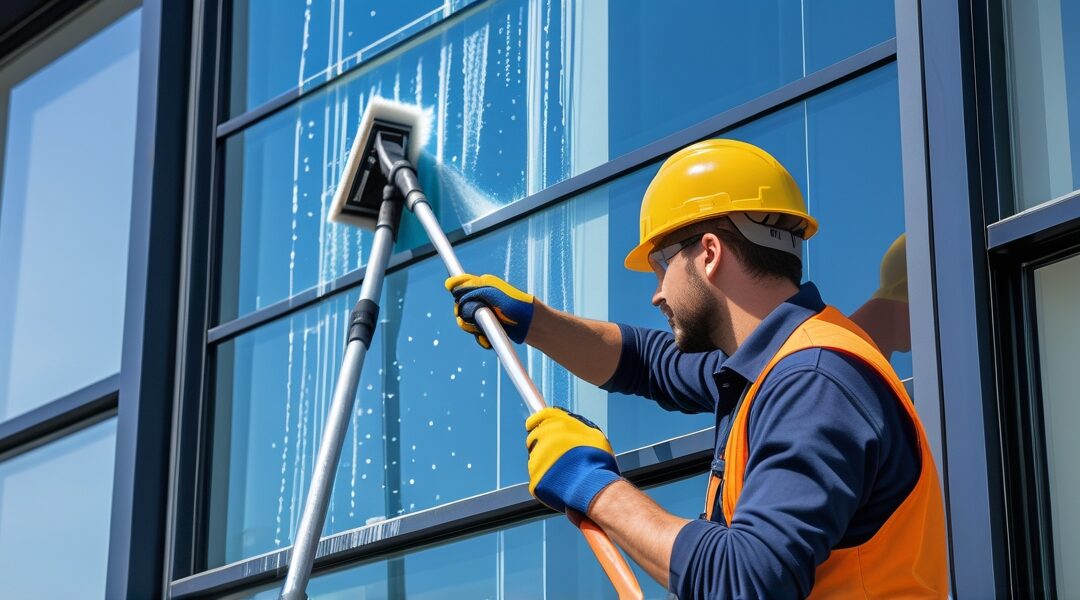
- Helmet with chin strap, eye protection and gloves suitable for wet/chemical work.
- Non-slip footwear with adequate ankle support.
- Weather-appropriate clothing and high-visibility garments when working near traffic.
- Ropes, anchors, winches, and mechanical devices inspected and logged by a competent person — with pre-start inspections before each shift.
Chemical handling and environmental controls
Window cleaning often uses detergents and specialised cleaning solutions. Contractors must manage chemical hazards by:
- Obtaining and keeping Safety Data Sheets (SDS) for each product on site and ensuring workers can access them.
- Using appropriate PPE for chemical use (gloves, eye protection) and following manufacturer mixing and usage instructions.
- Storing chemicals securely, labelled and in accordance with dangerous goods requirements if they meet classification criteria.
- Preventing runoff into storm drains and waterways — use containment or capture systems and dispose of wastewater according to local council requirements.
- Training staff in first aid and spill response procedures relevant to the products used.
Waste disposal and environmental obligations
Disposal of cleaning wastes, wastewater and chemical containers must comply with environmental law and local council requirements. Contractors should:
- Use methods that prevent contaminants entering stormwater systems.
- Collect and remove solid waste and empty chemical containers for appropriate disposal or recycling.
- Check council rules on discharge to sewer; some councils prohibit washing down contaminants into public drains.
- Keep records of waste disposal and any permits obtained for special waste handling.
Traffic, public safety and council permits
Exterior window cleaning often impacts pedestrians and road users. Practical obligations include:
- Implement traffic and pedestrian management plans where work affects footpaths or road lanes.
- Apply for hoarding or footpath occupancy permits from the local council when required.
- Use signage, barricades and qualified traffic controllers for work adjacent to roads.
- Comply with council requirements for noise, operating hours and safe use of public space.
Inspections, audits and continuous improvement
Maintaining safety requires regular monitoring and improvement:
- Conduct routine workplace inspections and equipment checks, and document findings.
- Audit SWMS compliance and training currency for all personnel.
- Investigate all incidents and near misses and implement corrective actions.
- Hold regular toolbox talks and refresher training in fall prevention and rescue procedures.
Emergency planning and rescue
Rescue capability is non-negotiable when workers are exposed to suspension or entrapment risks:
- Develop a job-specific rescue plan for rope access and EWP scenarios.
- Ensure rescue equipment is on site and that nominated rescuers are trained and competent.
- Test rescue procedures during induction and at intervals determined by risk.
- Coordinate emergency communications with site managers, building owners and emergency services if needed.
Training and competency
Training must be relevant to the tasks and equipment used. Typical competency requirements include:
- Work at heights training (covering hazard identification, control selection and use of PPE).
- EWP/operator training for specific platform types.
- Rope access certification where applicable (IRATA/SPRAT-style or equivalent).
- Manual handling and chemical handling awareness training.
- First aid training, including dealing with suspension trauma and chemical exposure.
Practical compliance checklist for contractors (summary)
- Complete site-specific risk assessment and prepare an SWMS for each high-risk job.
- Ensure all workers hold appropriate training and licences for their tasks and equipment.
- Use the hierarchy of controls — avoid heights, use collective controls, then PPE.
- Inspect and maintain all equipment and keep inspection records.
- Implement traffic/pedestrian management and obtain council permits where required.
- Manage chemicals with SDS access, correct storage and spill prevention measures.
- Prepare and practise rescue plans for rope access and EWP incidents.
- Keep accurate documentation of training, inspections, incidents and waste disposal.
For contractors seeking local professional services or examples of compliant window cleaning operations in Melbourne, consider well-established operators who publish safety information and service details — for example window cleaning Melbourne. These resources can show how companies structure their compliance and operational procedures in real-world settings.
For broader cleaning and maintenance industry insights and safety-related articles, consult reputable industry blogs and publications such as those provided by experienced service providers.
For further reading and authoritative guidance, refer to:
- WorkSafe Victoria — guidance on work at heights, licensing and managing risks.
- Safe Work Australia — model codes and resources on fall prevention, hazardous chemicals and general duties.
- Relevant AS/NZS standards for fall-arrest systems and equipment.
- Local council websites for permit and public space use rules in Melbourne municipalities.
Additional industry content and case studies can be found on commercial cleaning and maintenance blogs; for example: https://www.stanleysteemer.com/blog
Final notes — practical steps to start immediate compliance
To get started, contractors should:
- Review the latest guidance from WorkSafe Victoria and Safe Work Australia relevant to window cleaning and working at heights.
- Create or update SWMS templates specifically for window cleaning tasks and equipment types you use.
- Schedule an equipment audit and ensure all fall-arrest gear and EWPs are inspected and tagged.
- Book refresher training for staff in EWP operation, rope access and first aid.
- Liaise with local councils to clarify permit requirements for the areas you work in, particularly in CBD and heritage areas of Melbourne.
- Establish or update rescue procedures and practise them under supervision at least annually or when conditions change.
Adopting a safety-first approach not only meets legal obligations but also reduces downtime, lowers insurance costs and enhances client trust. If you need help interpreting specific legal obligations or designing job-specific SWMS, consult a safety professional or contact WorkSafe Victoria for regulatory guidance.
https://shorturl.fm/4zjys
https://shorturl.fm/gDjDd
https://shorturl.fm/HjF3G
https://shorturl.fm/mvWOW
https://shorturl.fm/ONZPR
Just stumbled upon fortunemouse4 and gotta say, I’m impressed. The site is slick and easy to navigate. Looking forward to seeing what else they have to offer! Check it out fortunemouse4, you might just get lucky.
https://shorturl.fm/lsDIo
https://shorturl.fm/P5auw
https://shorturl.fm/qEl1A
https://shorturl.fm/eWqbj
https://shorturl.fm/XepRu
https://shorturl.fm/cuLY6
https://shorturl.fm/o9TgA
https://shorturl.fm/3hrZl
https://shorturl.fm/sluRB
https://shorturl.fm/v2m4r
Having a blast with fun88bong88! Great selection of games and always something new to try. The promotions are also a nice bonus. Check it out, you won’t regret it! fun88bong88
Been playing on neu88net for a while now. Pretty decent, honestly. Game selection is solid and I haven’t had any major issues withdrawing. Could be better, but it’s worth checking out. neu88net
https://shorturl.fm/le5bl
https://shorturl.fm/80GU5
https://shorturl.fm/CIPma
https://shorturl.fm/ZObOl
Earn your airdrop on Aster https://is.gd/ZceEI6
68jl https://www.68jlj.org