
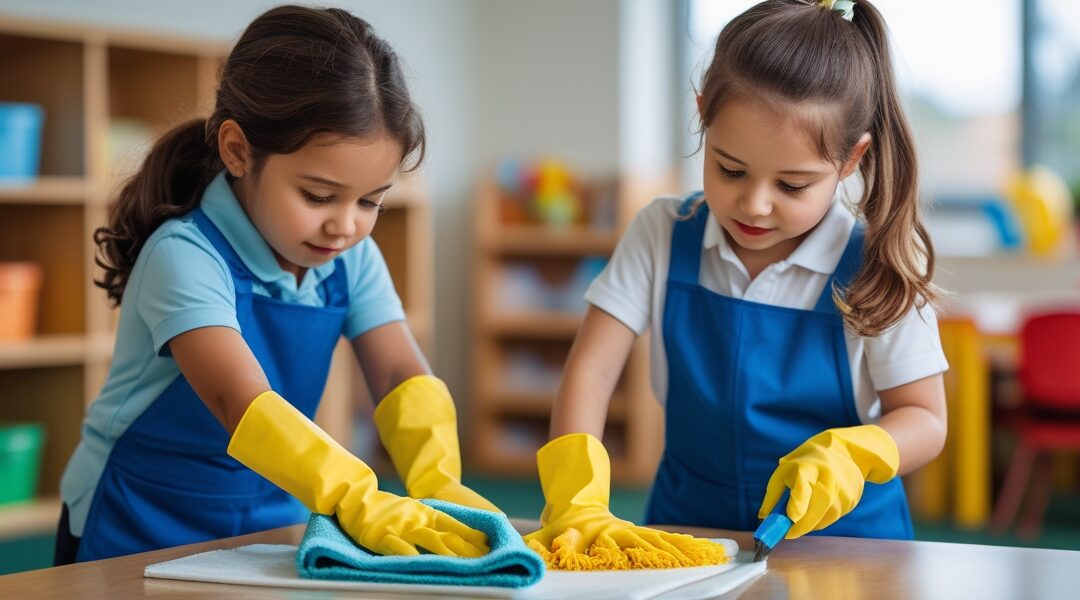
childcare cleaning services.
For broader facility management perspectives and complementary advice on cleaning standards and procurement across industries, see a national facilities blog resource: Citywide Facility Solutions — blog.
Outbreaks and incident cleaning (vomit, faeces, blood)
In the event of an infectious incident:
- Isolate the immediate area and remove children to a safe space.
- Staff performing the clean should wear appropriate PPE (gloves, apron, mask if required) and follow the service’s outbreak and infection-control procedure.
- Remove visible contamination using disposable absorbent materials, then clean and disinfect the surface with an approved disinfectant and required contact time.
- Dispose of contaminated waste as clinical waste if required by local guidance and in line with Health Victoria procedures.
- Record the incident, cleaning actions and notify parents and public health authorities as required by regulation.
Training, documentation and audit
To remain compliant and defensible at audit:
- Document cleaning schedules, incident cleans and product SDS in a central register accessible to staff.
- Train staff on correct cleaning techniques, product use, dilution and PPE handling — refresh annually or when products/procedures change.
- Conduct regular internal audits of cleaning checklists and corrective actions; include sample sign-offs by educators for room-level daily checks.
- Engage a third-party professional clean for at least quarterly deep cleans and maintain a contract that specifies scope, frequencies and response times for infectious events.
Printable master checklist (copy into your service policy)
Below is a concise checklist you can paste into policies or staff rosters. Use a daily sign-off by the educator/cleaner for accountability.
- Daily — Classroom: sweep/vacuum, mop, disinfect high-touch surfaces, tidy toys, wash mouthed toys.
- Daily — Bathrooms/Nappy areas: clean & disinfect, restock soap, empty bins.
- Daily — Kitchen/Eating areas: clean benches, sanitise tables before/after meals, fridge check.
- Weekly — Toys & soft furnishings: launder/clean, deep-wash hard toys, vacuum rugs.
- Monthly — Outdoor equipment and HVAC grilles: wash and inspect.
- Quarterly — Professional deep clean and policy review.
- Incident — Follow outbreak protocol, PPE, disinfect to manufacturer contact time, record and notify.
Frequently asked questions (short)
Q: How often should mouthed toys be cleaned?
A: Immediately after being mouthed, or at minimum daily if in frequent use.
Q: Can we use household bleach for all disinfection?
A: Bleach is effective but must be diluted correctly, prepared daily, and used safely. Alternative TGA-registered products that state efficacy for childcare pathogens may be used. Always consult SDS and manufacturer instructions.
Q: What records should we keep for audit?
A: Daily cleaning sign-offs, incident clean logs, SDS register, staff training records and any deep-clean contractor invoices and scopes.
Final notes — governance and continuous improvement
Maintaining a compliant and practical childcare cleaning checklist requires governance: review your policies annually, update products and procedures when state guidance changes, and embed cleaning responsibilities in staff induction. When in doubt, consult Health Victoria, Early Learning Victoria guidance and your local public health unit for outbreak-specific directions.
Keeping documentation, training staff and contracting professional support where necessary will help your service demonstrate compliance with Victorian and national expectations in 2025 and beyond.
https://shorturl.fm/hRk3T
https://shorturl.fm/qoNHi
https://shorturl.fm/AVuAZ
https://shorturl.fm/6Ls0a
https://shorturl.fm/OW65d
https://shorturl.fm/RiVOY
https://shorturl.fm/AA0hT
https://shorturl.fm/NqU0N
https://shorturl.fm/EazJC
Heard 74betlogin is pretty decent for quick bets, guess I’ll give 74betlogin a shot!
https://shorturl.fm/b1XsB
https://shorturl.fm/zJVMY
https://shorturl.fm/elygK
https://shorturl.fm/PhFNd
https://shorturl.fm/TOdLZ
https://shorturl.fm/meTGB
88win01 is a solid choice for those looking for a reliable online gaming platform. I appreciated the variety of games and the competitive odds. The site’s easy to use and bonuses are pretty generous. Give it a looksee: 88win01
https://shorturl.fm/e0f0A
https://shorturl.fm/79E1O
https://shorturl.fm/a4Cqf
https://shorturl.fm/aFOnT
https://shorturl.fm/RrWCC
https://shorturl.fm/m9yBK
Dangnhapbj88 is offering some cool promotions right now. Definitely worth a look if you’re trying to maximize your winnings. Sign me up with dangnhapbj88.
Just signed up at b777casinologin and the login process was super simple, which is a big plus for me. Haven’t explored everything yet, but first impressions are good. Easy login is everything! Give it a try: b777casinologin
23betwin has been decent to me. No major complaints. The odds are usually pretty competitive. If you wanna try your hand, give it a shot. Check it out: 23betwin
RK88COM. Alright site. No huge wins yet but I haven’t lost all my shirt, so that’s ok. The site works fine. That’s good eh? Give it a peep: rk88com
The Raybet download was simple enough. Haven’t used the site much, but setting it up was a breeze. That’s half the battle right? You want to try download it too? See this: raybetdownload
https://shorturl.fm/Sz02m
https://shorturl.fm/zq6rM
Special ability to earn $ASTER bonus https://is.gd/CGTnqR
It’s fascinating how accessible online gaming has become! Seeing platforms like JLJL22 offer quick registration & easy deposits (even crypto!) is a big plus. Thinking of checking out the jljl22 apk – seems user-friendly for casual players like me. Hope it’s a fun experience!
Fast indexing of website pages and backlinks on Google https://is.gd/r7kPlC
Fast indexing of website pages and backlinks on Google https://is.gd/r7kPlC